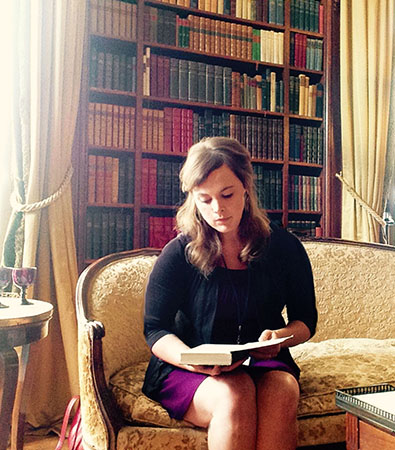
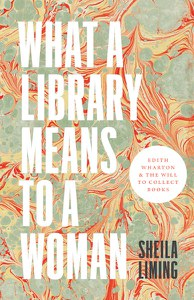
Sheila Liming is associate professor at Champlain College in Burlington, Vermont. She is the author of What a Library Means to a Woman (University of Minnesota Press) and Office (Bloomsbury), both published in 2020. Her writing has appeared previously in the Los Angeles Review of Books as well as in The Atlantic, Lapham’s Quarterly, Public Books, The Point, The Chronicle Review, and elsewhere.
Dr. Liming’s discussion with The Ivory Tower Boiler Room covers a wide range of topics from discussing her archival work at The Mount (Lenox, MA), specifically how she created a digital library for them, writing about university precarity, her Wharton fanaticism that inspired her book What a Library Means to a Woman, and being a Country Music enthusiast.
We cover so much ground, in our one hour conversation, and here are a few questions that Dr. Liming answers:
How did you first learn about Edith Wharton and become drawn into her Gilded Age web?
What were some lightbulb moments during your PhD process? (This leads into an intriguing discussion about university precarity.)
Can you walk us through how your archive project at The Mount spurred the creation of your book, What a Library Means to a Woman? (You can find here book here.)
Do you remember when you first encountered the aura of the library?
What was it like editing the Norton Library edition of The Age of Innocence? (This leads to a discussion about Edith Wharton’s breast, yes you read that right.)
And, so much enthusiasm about traveling to The Mount and other author archives (for Andrew, it’s the Whitman Birthplace).
We’re scurrying around getting ready to celebrate one whole year here in the Ivory Tower Boiler Room. We’re so excited to celebrate a full year of being able to share interesting discussions with people who are passionate not only about their work, but also about sharing it with the rest of the world, and we’re so proud to have been able to bring attention to some really important topics in the academia–our mental health spotlight and our interview with Dr. Helana Darwin about her #MeToo PhD experience have not been easy for us to cover, nor do we expect that they were easy for you to listen to, but if we can help facilitate some of those difficult conversations then we are fulfilling a very important piece of our mission. And we hope you’ll join us on August 3 for our first birthday open mic event. It’s actually two events simultaneously, one online, the other in person in Pitman, NJ, at our official sponsor, Words Matter Bookstore. The online event is hosted by Erika, along with contributors to our site, Tiffany Sowa and Cameron Martin. The in-person event is hosted by Adam, Andrew and Mary.
Before that, on Saturday, we’ll be bringing you an interview with hiker, bagpipe enthusiast, and Edith Wharton scholar, Dr. Sheila Liming who came to us live from her childhood bedroom. She talks with Adam and Andrew about Edith Wharton, prestige, surviving university finances, and of course, teaching. There’s even something about library books and dog fur, too.
If you’re wondering what else there is to know about someone who studies Wharton, and hikes and plays the bagpipes, Dr Liming answered our Ivory Tower Boiler Room questions, and here’s what she had to share with us:
1.What are you listening to, reading, watching?
I’m always reading multiple things simultaneously, so right now, that includes Colin Jerolmack’s Up to Heaven and Down to Hell: Fracking, Freedom, and Community in an American Town (nonfiction, 2021), R.O. Kwon’s The Incendiaries (fiction, 2018) and Margaret Grebowicz’s Mountains and Desire (philosophy, 2021). I’m listening to a lot of ambient piano music, like the Dutch composer Joep Beving, because I need wordless beauty to keep me writing and reading. And, because I’m always very behind on TV, I’m watching the series Borgen, which I find exceedingly stressful.
2.Do you like to cook? What is your favorite thing to make?
Very much. It’s summer, so I’m cooking fresh fruits and vegetables–all manner of them. Lately, I’ve been barbecuing whole heads of cauliflower and clearing my schedule in anticipation of tomato season.
3.What is something you have read and loved, and wish more people would read?
Olga Tokarczuk. I read her Drive Your Plough Over the Bones of the Dead last winter and cannot get it out of my mind. What a novel. What a style. What a voice. Absolutely original and smart as hell.
4.Did you grow up with video- or computer-games? What were/are some of your favorites?
Yes, but back in my day that meant Mario Brothers games on the old Nintendo, and that’s where my skills have stagnated. (I put some pandemic time into Mario Galaxy in deference to this fact, but I am no virtuoso.)
5.You’re taking a sick-day from work. What movie are you putting on.
Paddington 2, no question.
6.What’s your favorite excuse for why you have writer’s block?
I need to read more.
7.What’s a book everyone says you should read, but you either read it and hated it, or haven’t read it.
Every Henry James novel that isn’t Portrait of a Lady is frankly overrated, and I’ve been induced to read all of them thanks to people saying I should.
*
The Boiler Room occupants are filling their time with more than just party planning, writing and work, and so from the Boiler Room, we bring you our recommendation for the week.
Adam has been in a bit of a funk this week, reading-wise, but has nonetheless managed to make dogged progress through Sholom Aleichem’s Wandering Stars. His music tastes this week have stretched to include some more recent stuff, like Rachmaninoff’s 2nd Piano Concerto and Tom Waits’s Small Change. He has been watching this new Netflix anthology called Ray (not to be confused with the biopic about the American musician), which is a modern take on the work of the great Bengali author/filmmaker/musician Satyajit Ray.
Erika didn’t get a chance to finish The Princess Bride Home Movie and is hoping that she might get to do that this weekend. It’s been an intense week with a lot of writing to catch up on for her, and so it’s been a lot of short YouTube content, especially Matt Baume, whose new Muppet video brought out all kinds of nostalgia. It’s hard to escape the influence of Disney where she is, and so this week, Defunctland has taken up some of the viewing time. She’s also been checking out iilluminaughtii. Netflix is calling to her with The Movies that Made Us for a little more nostalgia, and when she can focus on subtitles, there’s also Young Royals.
Something has drawn Erika to Shakespeare this week and she’s been reading sonnets again; not a bad thing to do for an aspiring poet, although Erika admits she doesn’t have the patience for poetic styles that require paying attention to rhymes and syllables. Twelfth Night has been beckoning to her, although a whole play feels like a lot at the moment and may have to wait until some other projects are finished first. Taming of the Shrew might also land in the “to read” pile soon, too. Another “highlight” from the week would be the slash fiction she happened across about Avram and Tommy from The Frisco Kid, (if we assume that “highlight” means “things that she never thought existed, and definitely never thought she would read.”) She’s hoping to start Atonement Camp for Unrepentant Homophobes soon, too.
It’s a chicken or egg question, which came first–a desire to read sonnets or a desire to listen to Kiss Me Kate; both came about on the same day as a way of dealing with writer’s block this week. Camelot also landed on the playlist, too. And because we were into kings and castles, Six The Musical also went back into the rotation. John Field’s Nocturnes have been popping up once in a while; although Erika stands firm in her preference for work from the Baroque and Classical eras, she is grudgingly acknowledging that not all of the Romantic work is too melodramatic to listen to.
The White Lotus Hotel on HBO is Mary’s new show to watch. New episodes air every Sunday. It’s a great way to close the weekend.
Mary is listening to the newest episode of Dark History hosted by Bailey Sarian. This episode is about the origins of birth control. To no one’s surprise, birth control was not about women’s rights but about population control.
Andrew is coming to us from his vacation in Atlantic City, with a read/watch/listen special report.
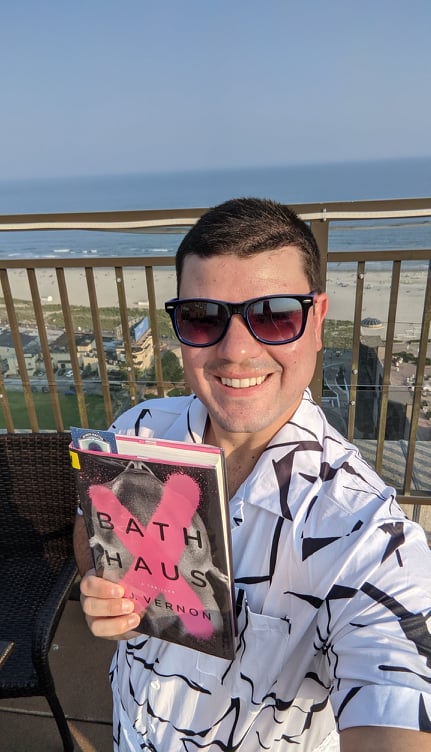
In it, he’s packed The New York Times’ Summer Reading special issue, which he says is “a really good beach read.”On location, Andrew began Bryant Simon’s Boardwalk of Dreams), and tells us, “it’s such a meta reading activity,” since he’s reading it while looking out at the Atlantic Ocean and passing back and forth from the Claridge Hotel to the beach. He hopes to have Simon on in the future to discuss Atlantic City’s storied past. And, he’s about to start reading P.J. Vernon’s Bath Haus, which he knows will be quite a beachy, steamy (literally), queer-aesthetic, immersive experience. There is more to come about and he just caught up with a scene that left him with so many questions (all he can say, without spoiling it, is watch out for Jennifer Coolidge’s character…wow!).
In college, one of my friends used to say “dancing is a vertical expression of a horizontal desire.” We would go dancing at least once a week, almost every Saturday night was reserved for going to Tracks, a big gay dance club in Washington DC. Some weeks, when money was tighter, we’d go early, when there was no cover and the club was empty, and wander and dance until it got busy and crowded, and smoke and drag queens crowded the bathroom (the men’s room was for masculine men to use as intended, and for men to hook up… everyone else was in the other bathroom.) When the crowds showed up, it was like being caught in a riptide, I’d fade into another state of being, moving with the pounding rhythm, watching the people who were watching me but not really seeing anything, just existing and moving, not noticing until the night ended how my feet hurt, or my muscles were sore, and, after a late-night meal with friends, the location entirely determined by whether our budgets required us to use our university meal plan, always grateful for the embrace of my mattress, and sometimes the company of someone else.
After the Pulse shooting here in Orlando came the “Keep Dancing, Orlando” campaign, and, while it may sound trite, it was one of the things that would lift up my mood in some of the dark moments during the weeks that followed… and it was a way to talk with my kids about how people far away were helping to take care of the mental health of people in Orlando. (I don’t normally use the phrase “taking care of mental health,” though. I much prefer to call it “fighting off the brain-weasels.”)
One of the memories closest to my heart was the night I was at a Dance New England event with someone I was dating at the time. I was about 21, and still struggling with the kind of body-confidence-issues and insecurity that so many people, especially women, face. I was wearing a black t-shirt and super-soft dark green pants (my favorite thing to wear to these events). It was very warm, so I’d pushed the elastic cuffs up over my calves. I was sweaty and barefoot, my hair was a mess, and I was there for the joy of movement, which was all that mattered. And my date came to me while I was getting a drink and catching my breath and said to me, “I love watching you dance. You look like you’re at home in your body.”
I needed those words. They made such an impact on me, and really did describe how I felt when I was dancing. It wasn’t about anyone or anything else, it was about moving joyfully, and feeling present, and loving what my body could do or what I could do with my body (which way that went depended on whether I was being watched and whether or not I wanted to be watched.) It was a turning point for me in the confidence I had. No matter what I was wearing, I felt a kind of ownership of my own body and my own self when I was dancing.
Even when going out to a club on a Saturday night or to other dance-focused events wasn’t a part of my life anymore, I still loved a good living room dance party with my kids or “car dancing” while we were driving somewhere and a really good song came on. Just dancing around the kitchen while cooking and listening to good music was fun.
Was.
I’ve been dealing with joint issues my whole life, and chronic pain (which turned out to be fibromyalgia, but it took thirty years to diagnose that) since I was fifteen. In the last few years, I added another connective tissue disorder to my tally, and, if avoiding COVID wasn’t enough stress, in 2020, I got sick enough to need to spend about a month recovering… first in the hospital and then in a rehab facility. That hospital stay meant that in some ways I was “better,” but it also meant I could no longer ignore or downplay (as much) the permanent impact that just dealing with things was having, and would continue to have. I came home with a walker, a wheelchair, a chip on my shoulder, and a lot of new things to learn.
There were a lot of basic things I had to learn to do while managing the new equipment. Try manipulating a walker (which requires two hands,) and carrying your groceries into the house, or feeding the cats. Stepping over the edge of the bathtub? That’s new and different, too. My favorite brunch place? Parking is a minimum of several blocks away. Then it requires going up stairs to enter. Going to brunch there with mobility gear also requires entering through a back entrance, making your way all the way to the front of the restaurant and then being shown to your table. There’s also the way you can’t get a wheelchair under the bathroom sink, which means if I’m using my chair (which I prefer when I go out), washing my hands would be as if you got a chair (make sure it’s got armrests), set it in front of your bathroom sink, had a seat, and then tried to wash your hands. It complicates things. How about moving a basket of laundry? I’m sure that watching me manipulate a bag of trash into the city-issued trash can (which is almost as tall as I am) is probably quite entertaining.
Losing simple things that bring joy…that’s one of the hardest things. Wandering the aisles of the bookstore or the yarn store is now much more complicated, especially if aisles are narrow or places are crowded. If I want to go enjoy the park? Only if there’s a safe path to walk, and it should be no surprise to anyone that one of our favorite playgrounds doesn’t have any kind of a path at all from the parking lot to the playground, which means it’s off limits for me, because the uneven terrain makes it unsafe with the walker and nearly impossible with the wheelchair.
The chair makes me into an object, not a person; instead of asking me to let them by, they’ll just move me out of the way. While I have your attention: don’t ever do that to someone in a wheelchair, and don’t assume that, just because I’m in a wheelchair, I can’t walk.
It was a relief to finally have answers to why everything hurt. It meant there was a way to start controlling how much it hurt, because it’s never not going to. There might not be a way to stop all the joints popping out of place all the time; knees still need popping back where they belong regularly, and there are some things that I do that make most people squirm, but things like ankle braces have made others more stable. But that relief is fragile, and the grief and anger are deep.
Anger that it took so many years to get answers. Anger that people don’t know how to deal with disabled people. Anger that I have to ask for so much help and so much consideration, but also that I feel like asking for consideration is burdensome and I don’t know how to advocate better for my own needs in this arena. Grief for things that have changed so much that it’s now onerous to do them.
But emotions, like so many other things for anyone who doesn’t fit whatever is the ideal, the pinnacle, the prime example of (fill in the blank here), are policed. I’m not supposed to be angry. I’m not supposed to be sad. I should be grateful for the opportunities I have. I should appreciate the so-called help (which isn’t necessarily helpful… don’t grab a door from my hand if I’m holding on to it, please, and if you’re going to hold a door open for me while I steer my chair through it, where you stand when you’re holding it does matter. And I do know that a lot of your motivation is about doing what makes you feel good, not what I need.)
I am supposed to be some kind of inspiration to other people because I’m overcoming challenges. But I miss dancing, and that makes me sad. I get frustrated at the amount of extra time it takes to do everyday things. I worry about being able to go to places I love (it’s far too complicated to get into now, but the way the medical establishment devalues disabled lives makes the risk of COVID exponentially greater.) I’m not interested in being inspirational for just existing. I’m learning to live my disabled life, which means discovering who is trying to silence that voice, and who doesn’t want me to express the whole range of emotions. I’m guarding my time a lot more carefully. I don’t have time to fake it so other people aren’t uncomfortable anymore. My whole disabled life means whole; all the labels, all the emotions, every part of me. And if that means I have to learn to be angry sometimes, I’m going to do that.
The big news-item this week is that we’re gearing up for the party, half of which will be taking place on Zoom, and the other half of which will be taking place in the abode of our very own sponsor, Words Matter Bookstore. Andrew, Erika, Mary, and Adam are excited. Tiffany Sowa and Cameron Martin are excited to be guest-hosting the Zoom-event from Oklahoma and Idaho, respectively, along with Erika Grumet (who is in Florida).
Big Cat is excited! (Ok, Little Cat is excited too, but he holds his cards pretty close, so you’d have to know him pretty well to pick up on the change in vibe.)
But just because we’re excited about the party doesn’t mean we forget to do the usual fun stuff! Tune in to the Podcast this Saturday to hear us catching up with Sheila Liming–Edith Wharton scholar, college professor, bluegrass picker, bagpipe enthusiast–about her experiences doing archival research, holding the line against a university’s budget-cuts, and, of course, teaching. An important theme of the podcast is: people who want to be associated with the prestige of a university but do not want to have to pay to fund it. Dr. Liming will also hold forth on her major contribution to the digital humanities: EdithWhartonsLibrary.org.
We’re feeling festive, what with coming up on One year of magnificent teamwork, so here’s another episode of…
Big Cat Little Cat
Script by Adam Katz. Photography by Erika Grumet. Big Cat and Little Cat are played by Frob and Widget, respectively.
*
*
*
Description: Two identical panels, each depicting the interactions of two far-from-identical cats. The cat on the left is large and orange and looks down on his partner with a sunny disposition; the cat on the right is small and grey and looks out of the frame with an air of indeterminate frustration. Little Cat asks: “Big Cat, do you think we should go to that open mic night at Words Matter?” Big Cat responds: “Two words: ‘poetry,’ ‘sandwiches.'” Little cat perks up a bit and says: “Ooh! I’ll get my coat.” Big Cat says: “You’re… already wearing it.”
So here’s why I like Never Have I Ever. I’ll start by saying that I’m a Jewish person who is in a relationship with an Indian woman—actually a Tamil woman, so, not far off from the main character of this show, except for the technicality of being born and raised half a world away.
Naturally the Ms. and I got to talking about this show, which we have both seen, and she asked: “Are you Team Paxton or Team Ben?” I had not been informed that there were teams, and took a moment to respond.
Finally I said: “Are you seriously asking me whether I’m rooting for or against the nerdy Jewish guy who’s infatuated with an Indian woman?”
“Yeah,” she agreed, “And whose dad is a lawyer?”
“Exactly.”
“So tell,” she rejoined. “I’m team Paxton. Are you Team Paxton or Team Ben?”
Anyway. What is this show good for besides fueling my banter with my friend of friends, whom Covid has kept 7,000 miles distant for far too long?
Well, it’s a good example of how to take typical sitcom structures and squeeze the racism and sexism out of them. Take the main character, Devi. She is an overachieving nerd with no athletic interests, much less prowess, and magnificent anger issues. Also she keeps trying and failing to be sexually promiscuous.
Been there.
But whom did they get to narrate her story? Tennis star John McEnroe. Most sitcoms don’t have a narrator at all. This one does. And it’s John Frigging McEnroe. Why?
His selection appears to be a commentary on who is allowed to be angry, stupid, and promiscuous. Athletes are allowed to be all of those things. A young girl of color in her sophomore year in high school is not. Until now. So putting him in her sitcom somehow makes her more relatable to people who are used to forgiving sports stars their ‘eccentricities’ (read: personality disorders).
I’m naturally drawn to sympathize with young people who make terrible decisions and have anger issues, because, duh, I own a goddamn mirror. But not everyone is willing to cut a sitcom protagonist that much slack; especially one who doesn’t look like them. Fortunately, my boy John McEnroe, who I hear is a very good tennis player (my grandfather liked tennis. I once watched Roger Federer knock the stuffing out of Andy Roddick, but that was the extent of my engagement) is killing it in his second career as the narrator of the fictional events in the life of a fictional girl. He establishes his role early on—in the first episode, in fact, in the scene that features the main character, Devi, breaking a window with her textbook. His voice-over explains in soothing baritone: “this is how us hotheads boil over.” The subtext has become text: if you don’t blink when John McEnroe or Tommy Lasorda throws a Gatorade-cooler or bawls out an umpire, you don’t get to blink now.
Despite being Jewish and thus growing up in the shadow of a traumatic past (one grandmother left Germany in 1939; one great-grandfather left Russia in 1902 just ahead of the angry mobs) I have rarely experienced racism directly (rarely, but not never). But I’ve heard people say some questionable things. I have probably said some myself before I was old enough to know better (and, more likely than not, after, as well). In any case, I see the value, no, the necessity, of untangling these old knots, and I appreciate watching a show that tries to do just that.
As this article was about to go to press, Erika pointed out that there was some discourse over whether the depiction of Ben is anti-Semitic. I just want to nip this in the bud. If he feels like a person, he’s not an anti-Semitic depiction, and Ben definitely feels like a person. Maybe it’s because, growing up in a well-off, predominantly Jewish suburb, I knew about 30 Bens.
Anyway, whatever else it may do, I appreciate a show that tries; so many shows do not. So goddamn many. Anyway, here’s a “Big Cat, Little Cat.” Enjoy!
*
Big Cat, Little Cat
Written by Adam Katz; Photo by Erica Grumet; Big Cat and Little Cat are played by Frob and Widget, respectively.
*
*
*
Description: Two cats are sitting on a bed. The big, orange cat on the left takes up about half of the total frame; the little, grey on the right, less than a quarter. The little grey looks pensively out of the frame and asks: “Big Cat, when you wake up, do you remember your dreams?” Big cat smiles down and answers: “Well. It’s a bit embarrassing, but I’ve always wanted to poop outside the box.”
I don’t usually think of myself as a teacher. I love teaching, but I also knew there was no way I could handle classroom politics, and so, in spite of encouragement from my parents to consider teaching as a career, I went in a different direction with my undergraduate and graduate degrees. What I ended up with is a social work degree which has allowed me to blend my love of teaching with other passions.
It’s no surprise that I would be bitten by the teaching bug. My parents actually met while teaching science in New York City (at the same junior high school) and my family is filled with teachers–teachers and lawyers. I had my first real teaching experience when I got involved with peer education as a high schooler. I loved doing the job and years later, I ended up also teaching and training peer educators and developing curricula for peer education programs.
I’ve done all kinds of teaching–Peer education, summer programs for elementary school kids, Girl Scouts–with both kids and adults, but I never think of myself with the label “teacher.” (It’s strange how my sojourn in the Boiler Room has really adjusted the way I think about my own labels sometimes. Teacher, writer, what’s next?) I don’t think of myself as a scholar either, not when I sit with Andrew or Adam, for example, and enjoy their encyclopedic knowledge and incredible recall of literature. They are scholars and they are teachers, not me.
Except that I facilitated the discussion in the two-part round-table about mental health in the university. And the following month, I took personal history and blended it with factual content to write the piece about HIV., There was also the piece I wrote about ice cream and bisexuality, which Adam, ever the one to analyze my writing, described as “an info dump disguised as a puff piece.” The message I sent back was “I was trying to make it accessible. Science writing is hard!” It’s hard for me to think about those pieces as the work of a teacher, but what else could they be? What these subjects have in common–mental health, disability, AIDS, bisexuality–is that they are all fields that, for hundreds of years, have been uninteresting to the prevailing scholarly culture. Queerness, mental illness, and disability, are only just beginning to take their rightful place in scholarly discourse; and queer people, mentally ill people, and disabled people, as the experts in those fields, should claim our credentials as scholars and teachers. I’m not your science project; I’m not your anthropology observation. And I’m tired of seeing a panel of ‘experts’ testifying in Congress about pregnancy and the panel consists entirely of cis-gendered men who never have, and could never be, pregnant.
When I first came to the Ivory Tower Boiler Room it wasn’t as a member of the team, producing content, or anything like that. It was through the writing group; I’d been working on my own writing with Adam for a month or so in a much more didactic format than we work now; he messaged me one Sunday and suggested I join the writing group I came to the group as a student, only thinking about what I might learn from the group, and not thinking at all about the things I might share. I found that I’d get into these incredible conversations with Andrew, that led to me asking questions about his work, or about Whitman’s poetry, or drawing connections between things I never would have before (like last month when I brought up Walt Whitman and the movie Mean Girls together to make a point about the power of secrets.) Every once in a while, I’d feel like I said something useful. A Facebook thread about Chaucer one day led me to explain, in the comments, my strategy for reading and understanding Chaucer: I imagined the participants engaging in the kind of collective but competitive storytelling that happens sometimes at slumber parties. The people I was talking toacted like that was a novel approach for understanding that element of the story. I find myself surprised every time I have a valuable contribution to Ivory Tower discussions and every time I bring up things that people don’t know. It happened recently when I explained that hashtags with multiple words should have the first letter of each word capitalized for screen readers.
I tend to forget that “scholarship” and “teaching” don’t have to be formal things. I may have gotten a little excited when my Twitter feed was followed by The American Institute of Bisexuality, who publish an actual journal, which makes them feel “legitimate” to me, but that adherence to traditional definitions of “legitimacy” is really not helpful, and breaking out of that mindset is essential to breaking down other barriers of patriarchy, racism, colonialism, all the things that hold people back and prevent some voices from being heard. I’ve been quiet too many times when I had things to say, and I need to start remembering that I do have a valuable voice, with or without credentials. When I’ve trained new Girl Scout leaders, I talk about the girl-led element of the Girl Scout program, and how “girl-led” needs to be a part of how you run things from the time they’re in kindergarten, with more and more leadership in the hands of the troop as they grow, so that by the time they’re high schoolers, most of what the adults are doing are things that minors aren’t allowed to do themselves. What I do tell them is that the scouts are experts in themselves (and I tell the scouts this too, as I introduce ideas of leadership to them,) and that listening to them and engaging with their ideas is what’s going to lead to the most satisfying programs for everyone. When they tell you they want to build a rocket and go to the moon, you don’t tell them that dream is impossible…you tell them you love their enthusiasm and that it might not be something they can do at 6, but that you can all work together to figure out what steps might be involved in being able to do that, eventually. You can build different kinds of rockets together, and learn about space, astronaut training, and whatever else might be important to know, so that they can build a rocket and go to the moon one day. You can get them ready, and all of that can happen without setting foot in a classroom. And you’re still teaching them.
I think we forget sometimes that teaching is about passing on ideas. It’s not about the setting or the credentials or anything else. It’s about sharing what you know, encouraging someone else to dig deeper if they’re interested, and helping to connect new dots. It’s about helping people to think, and about collaboration, and sharing and passions.
I love collaborative learning. I love the exchange of ideas here in the Boiler Room. It’s why our round tables are so much fun and why the Big Think is so interesting…because we’re four unique perspectives giving completely different takes the same themes. I landed in the Boiler Room only approaching the environment as a student, not thinking about what I bring to others. That was a mistake. I have definitely grown as a writer since I found my way here. I’ve also learned about a lot of other things–new perspectives on familiar works of literature, how my own process works, how to give myself permission to claim my credentials and own my place at the table. I’m seeing how my perspective, which comes from an entirely different universe than the rest of the team (who all have literature-related backgrounds) has value to the team…and that sometimes that outsider perspective is really important.Just the other night, we were trying to come up with a response to a piece of mail we received from a listener who was obviously in distress. There were things I could draw on from my social work background that helped us talk about the situation and come to a solution.
We talk amongst ourselves about the mission and vision of the Ivory Tower Boiler Room, and we’ve begun using the phrase “liberal arts collective.” It’s through this collaborative culture we’re developing that I’m learning more about the value of my own voice. Teaching involves both listening and speaking, and if I undervalue my own voice or my own perspective, or get hung up on titles and credentials, then I’m depriving myself and others of an opportunity to learn something new. My takeaway this month? I have a lot of learning to do…but it starts right at the center, with me.
We put all of this emphasis on credentials, and we forget that we are experts on our own selves, and you don’t need those degrees and stamps of approval to teach something; you just need to show up.
I get our WordPress notifications on my phone, just in case anything is urgent, or anyone has questions when they’re doing things on the website. I was so excited to get this notification, which capped off a week of big things for our blog.
It’s also a great way for us to prepare for our first birthday celebration!
And it’s also a great way for us to send Andrew off on vacation. He’s got beach reading to do (including our first book club pick) and other relaxing things planned. He also happens to be in the place where a book I love (Tiger Eyes) is set. There may also be taffy involved in this vacation.
Listeners, you are in for a treat. Not only is Lev Raphael the well-known author of lots of books from many different genres (particularly a series about queer sleuths solving crimes at universities) he is also among his interviewers’ favorite writers.
We have talked before on the blog about how his work was formative in helping Erika grapple with her queer, Jewish identity when she was a young person. Since we in the Boiler Room got together and started exchanging ideas, Erika and Andrew have also developed a vibrant back-and-forth with @LevRaphael on Twitter. This interview also represents a first for the podcast: Erika has never before appeared opposite Andrew as co-anchor. But given her long relationship with Lev’s writing, she just seemed the natural choice.
The three of them talk about getting away from your roots, life in academia, and generational trauma, as well as how to transmit history without passing on the trauma. There’s also some chatter about the Gilded Age, and about paying attention to details. You’ll also hear Andrew discussing many genres he has dabbled in, teaching his work in the college classroom, and being both inside and outside of academia. You’ll have to listen to the interview to hear how it all comes together, though.
As you listen, you’ll hear there’s something special about this episode (and Parts 2 and 3, scheduled to be aired in August). Sometimes you meet your heroes and they’re everything you hoped they’d be. What a fitting gift for all of us just one-and-a-half weeks from our First Anniversary Open Mic Night, hosted by Words Matter Bookstore.
“Yet Conscience is a nobleman, the best in us, and a friend.”
By Adam Katz
This is our hundredth post.
Solidarity takes work and engagement. So imagine my surprise when I saw a story covered by an independent media outlet to the effect that there has been a coal miners’ strike going on in Alabama for four months, and no national news source has covered it. Here it is in the Tuscaloosa News.
I am not a newspaper reporter so I will keep it brief (though not as brief as the actual newspaper reporters who have yet to cover this story at all).
Below is a screenshot of a Google search using the keywords “Warrior Met Coal Strike” (Warrior Met is the name of the company that bought several coal operations as ‘distressed assets’). The first page returns not a single major news site (unless you count Wikipedia). The sites (ABC, The New Republic, The New York Times) that have spent the last year (rightly so) reporting on the stripping away of first amendment rights governing peaceful assembly have failed to mention a story that includes 3 cases of vehicular assault against protesters.
I do not even deign to mention Warrior Met’s official reason, reported by the Tuscaloosa News, as to why there were 3 cases of vehicular assault within the space of one week: that the strikers were blocking the entrance to the factory. I don’t deign to mention it because, while there may be good reasons to run someone over with a car, “they were in my way” is not one of them.
I will also say that most grad students are members of unions; but we are not members of a grad student union; as far as I am aware, there is no such thing. I was a member of Communication Workers of America, and I stood with Verizon workers when they went on strike in 2011 (and 2016). Additionally, the things that happen to the striking miners also happen to striking grad students and other union members. For instance: the miners’ families lost their healthcare at the beginning of the strike. How is it possible to have a dialogue between labor and management when management can remove the healthcare of labor, essentially threatening them with death or medical bankruptcy? If we were in conflict with a country and we blockaded their ability to import medical supplies (which we lowkey do to Cuba and Iran), that would be a human rights violation. But at least those stories make the news. Here on US soil, as I said, a major publication has yet to bring up the story of the striking miners in Tuscaloosa. Ok one has.
It seems like a long time ago that I came up with the name “The Ivory Tower Boiler Room.” As these things do, the name came to me in a moment of inspiration–or clarity–but when I thought about the name, it turned out to be an appropriate name for a number of reasons. One is the sardonic idea that we may be in the ivory tower, but we’ll never make it to the top. But another—the main one—is that, as a former grad student, I have long felt more of a sense of solidarity and even similarity with the laborers both at the university (nurse’s aides, bus drivers, fast food workers) and in general (miners, factory workers, fruit-pickers) than with the professors I was working with and, at the time, anyway, working to become. Whatever other differences there might be, like them, I felt trapped at the bottom of an economic pyramid with little to no possibility of rising. One counter-argument always sat uneasily with me: that there is likely to be a world of difference between me, a privileged, white person from an upper-middle-class family, and a person who literally works in a boiler room. So the name is a promise. When there is a conflict between a person who works in a boiler room (or one works in a related field, such as coal mining) I will always take that person’s side. I have to.
I will say one more thing: newspaper reporters are often former grad students like us; and they are certainly writers like us. So why are we covering this story and they are not? Newspaper reporters are myriad, and the owners of newspapers are few. So why would these reporters not feel a certain sense of empathy for the eleven-hundred striking coal workers? Have there been reporters–at the times, the major TV stations, etc., who have tried to bring up the story only to watch it ‘caught and killed’ by senior editors? How could a big story like this languish for so long–a four month strike with three cases of vehicular assault perpetrated against the strikers? The answer may have something to do with the fact that Warrior Met is backed by at least three massive hedge funds, including BlackRock Inc., which is always in the news for something, and Renaissance Technologies, which is based in East Setauket and was founded by a former math professor at Stony Brook.
Please comment, share, and get involved. If the mainstream media does not support workers’ rights, then we have to do it.
The Boiler Room may be a great place for us to hang out, but it’s not a good place for us to celebrate our first birthday. For that, we’re going out into the world. Our podcast is turning one, and we hope you’ll join us to celebrate on August 3 at an open mic poetry reading event. (Two events actually…one in person at our sponsor, Words Matter Bookstore, for those who can make it to New Jersey, and one on Zoom.)
Other than planning our party, we are trying to enjoy summer when we can. Adam spent time away last week. Andrew is getting ready for a little time at the beach (and we promise to share more of his thirst-trap photos so he can show off his great… books.) Mary took a trip to an amusement park. Erika is just trying to stay cool and wait until February when the roles are reversed and the team has had enough of winter, so she can gloat about the sunny days she’s having.
This week’s guest on the podcast, Lev Raphael is one whose work first became an important part of Erika’s reading when she was trying to figure her own self out, and his book “Dancing on Tisha B’Av” helped her understand that it was possible for identities to be as intersectional as she was finding hers to be; she says it helped her to understand how to “embrace the and.” She suggested to Andrew that he might enjoy it, both because of the queer, Jewish perspective, and because of some of the fabulous Gilded Age settings. Erika kept her overexcited fangirl squeeing to a respectable level (a majestic feat when you realize that someone whose writing she likes and admires calls Erika “a writer” in spite of her struggle to adopt the label herself. She says she’ll get there, one day…it’s just a slow process). Lev was a delight to talk to, sharing advice and suggestions and telling interesting stories. By complete coincidence, he and Erika both had a chance to interview writer Erica Jong, and Lev encouraged Erika to write about that, so there may be a forthcoming piece about Erika at sixteen.
While our interviews are a great way to get to know our guests, there’s never enough time to find out all we want to know, and we love getting their recommendations for things, so, here are Lev Raphael’s answers to our Writer’s Questionnaire:
1. What are you listening to, reading, watching?
I’m currently enjoying Spoon’s Hot Thoughts and some Mendelssohn Quartets. I’m watching Berlin Station on Epix because it’s a great spy drama and I love seeing a city I wish I’d spent more time in on my German book tours. I’m reading the new Philip Roth biography because it’s been such a cultural flashpoint and also Unruly Desires about homosexualities and American sailors in the 1800s.
2.Do you like to cook? What is your favorite thing to make?
Absolutely. I find the whole process very zen–and that’s been amplified during the pandemic. I’m a big fan of pasta dishes and of frittatas. Challah French Toast is my go-to brunch dish and in the winter I often make the lentil soup from the Joy of Cooking. I read a number of different cooking columns and web pages and enjoy trying something new.
3.What is something you have read and loved, and wish more people would read?
I think Black Lamb and Grey Falcon by Rebecca West about the Balkans before WWII is an amazing blend of reportage, memoir, history, written with a novelists’ eye. It’s stunning, deep, rich, and unforgettable. I reveled in it while traveling in Europe one summer and it was perfect.
4.Did you grow up with video- or computer-games? What were/are some of your favorites?
I’d rather be writing. 🙂
5.You’re taking a sick-day from work. What movie are you putting on?
Moonstruck or The Bourne Identity. Maybe both if I’m really feeling low.
6.What’s your favorite excuse for why you have writer’s block?
I don’t believe in writer’s block and here’s my blog explaining why:
7.What’s a book everyone says you should read, but you either read it and hated it, or haven’t read it.
When I was on heavy rotation as a reviewer for the Detroit Free Press, other papers and some radio stations, I often felt pressure from publicity people, reviewers and even readers to like a book I found boring or just plain awful. I’ll keep my opinions to myself on this one because tastes vary so wildly, but I will say I haven’t read Ulysses and probably never will.
So much for what Lev is reading these days. The Team’s media recommendations for the week span the universe, as always.
Mary says she’s “reading nothing at the moment mostly because I don’t have time.” She’s already researching her next case for True Crime Tuesday though, and we know she’s reading for that…she just likes to surprise us sometimes.
For viewing this week, it’s been a revolutionary documentary made by the close friend of a murder victim. Instead of focusing on the killer, this documentary is about the victim-the person he was, how he was killed and by whom, and the twisted, horrifying events that take place afterwards. Mary is probably going to write about this in next week’s True Crime in Academia.
Mary is listening to a new case from Some Place Under Neith. This case is about a missing YouTube-famous child named Sophie Long. Her claim to fame started when her father, Matthew uploaded and shared a video to YouTube of Sophie begging him not to take her to her mother’s house. Some people saw this as a father’s last resort in trying to get help for his daughter.
Adam tried listening to the song ‘Love Shack’ by the B52s and immediately regretted it. God, what a shitshow that song is. It sounds like it was composed by an Enigma machine. Sorry. Neutral third-party narration resume. It’s been a light week for new music, (the greatest novelty has been listening to Gardiner’s version of Bach’s Mass instead of Raphaël Pichon’s) but not for new literature. Wandering Stars by Sholom Aleichem, translated by Aliza Shevrin and with an introduction by Tony Kushner (are you listening, Andrew?) Is proving as much of a delight as everything else Sholom Aleichem ever wrote. Do check it out! Also Last Stories by William Trevor–excellent, but not up to Trevor’s usual standards. Adam also finally had a look at the Netflix show ‘Never have I Ever,’ which turns out to be a delight, and surprisingly well-acted for a show about kids.
Erika apologized to Adam for making him listen to Love Shack (a Twitter thread of the B-52’s “Love Shack” rewritten in the style of Chaucer? Of course she had to read it, and share with the team). She’s been listening to Playing for Change and a lot of shuffling through her playlists. She hasn’t been able to settle into anything at all this week, and shuffling through familiar music is a little like comfortable sweater (comfortables sweaters are almost always too warm for in Florida.) After the Lev Raphael interview, where he encouraged her to write about her reflections on Erica Jong, and a conversation with Andrew, she picked up the novel Fear of Flying for the first time in many years. It had been her first exposure to Erica Jong, and she’s enjoying it in just as cringeworthy a way as the first time she read it, but the cringeworthy things are entirely different at this stage in her life. Between observing the holiday of Tisha B’Av last week and having the conversation with Lev Raphael, she’s also been reading from the Book of Lamentations (one of the shorter books of the Bible; Jews have the custom of reading it on Tisha B’Av) and the Book of Amos (which Lev referred to several times during their conversation.) She’s also reading Ray Bradbury’s I Sing the Body Electric, because she’s been watching The Electric Grandmother, which is based on the story. Way back when she was a kid, the public library used to screen movies for kids and Erika remembers seeing that film with her siblings and finding it very disturbing. Something about it recently came up in Facebook memories, and the film is on YouTube, so why not look? She’s also been watching The Princess Bride Home Movie, which she missed last summer when it aired on the short lived Quibi service. It’s on YouTube now, which means Erika can enjoy it. Erika is also hoping someone from the team will take a dive into creation-mythology from around the world with her soon…mythology has never been her favorite genre, but there’s something about a good origin story that Erika feels drawn to right now.
Andrew is reading Stuart Barnes’ Glasshouses. Andrew has such a nice Instagram relationship with Stuart and he wants to manifest Stuart as a future poetry contributor. As Andrew prepares for his Atlantic City vacation, he is pondering which books to pack, but one that he needs to bring with him is Boardwalk of Dreams by Bryant Simon. It’s a history of Atlantic City’s urbanization (he can’t wait to dig in since Andrew is about to write a ghost story set in Atlantic City in the 1920s).
Andrew is starting to get addicted to the HBO comedy The White Lotus, and, of course, he is watching the Real Housewives after writing to treat himself with this pleasure viewing.
The whole team is also getting ready to pick up PJ Vernon’s Bath Haus in preparation for the launch of our book club this fall. Watch for more details about it here, and an interview with PJ Vernon, too. While we’re often recommending books to each other, or reading books together, this is actually the first time all four of us will be reading the same thing at once, and it will be exciting to bring all the wonderful differences among us to the discussion. We may even discover similarities we didn’t know we had.
We’re looking forward to seeing you at one of our celebrations, in person or online! In the meantime, don’t forget to share your suggestions with us… future guests, things we should read, watch, or listen to, or even things you would like us to blog about. Or get in touch and let us feature your writing. We’ve got lots of space in the boiler room.