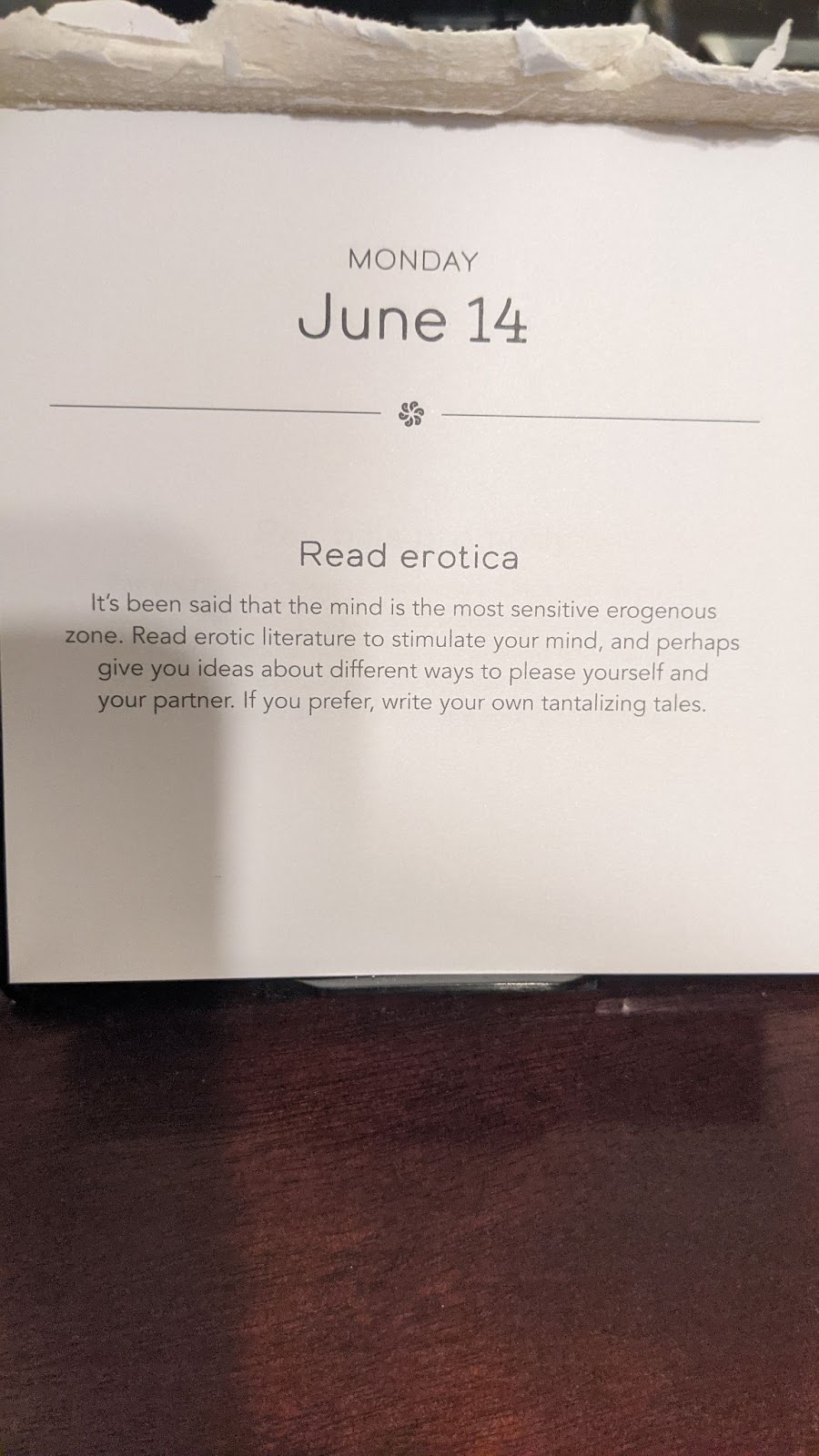
My bedside table calendar, the continued presence of Wharton’s spirit
It was around 11:40am when I attempted to reopen my laptop so I could login to the Zoom that would open up the portal for me to discuss Walt Whitman’s influence on Edith Wharton’s poetics. But, the dreaded phrase “Working on Updates” popped up on my computer and the percentage slowly increased as I watched the clock inch closer to 12pm (the time when the lecture was to begin). I joined the Zoom on my cell phone and explained to Jeff Zeh, the Port Washington Library programming coordinator, that these updates should be finished soon and I would then access my Zoom on the laptop. Well, the stars were not aligned. Or Mercury’s retrograde was playing tricks on me. Or something even more mystical had occurred…
Wharton’s ghost had taken over my laptop!
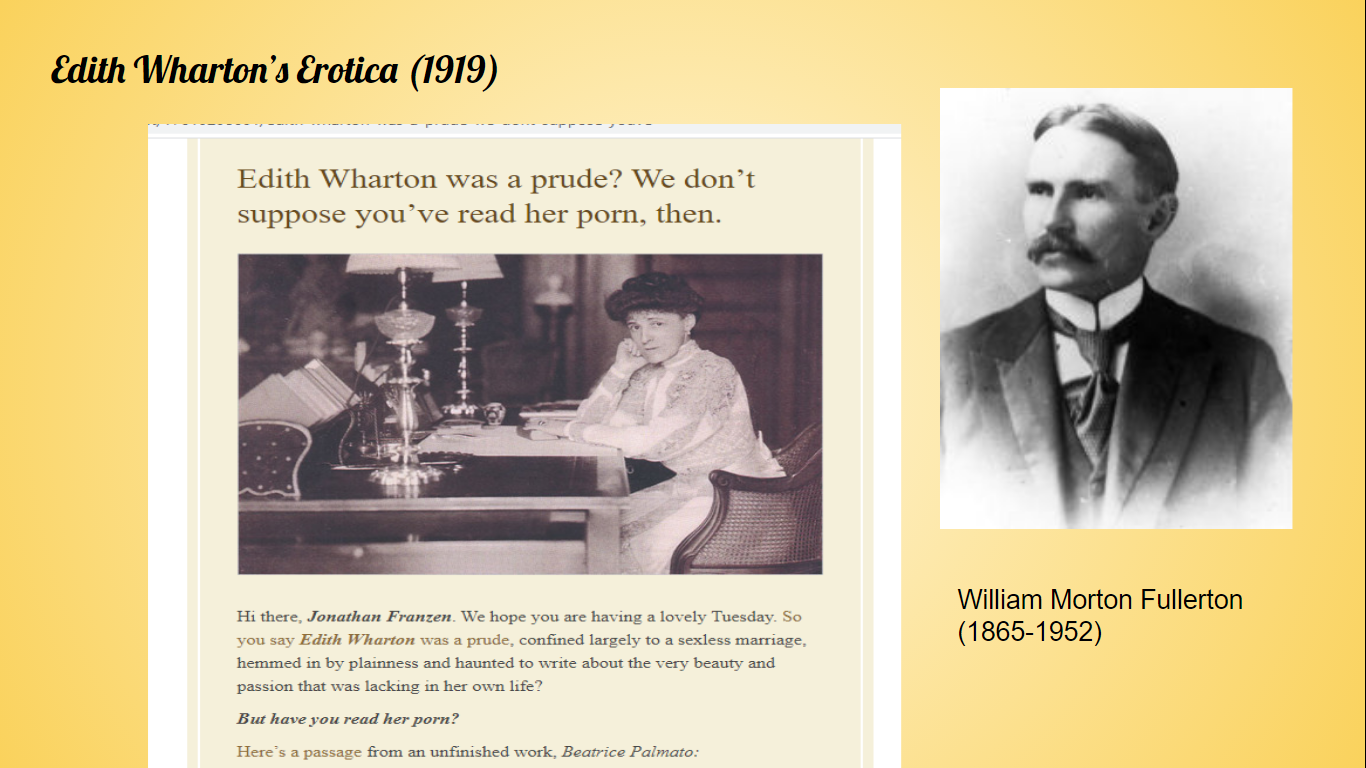
Before I had closed my laptop, I read over all my Google slides and was quite proud of the erotically charged lens applied to Wharton’s prose and poetics. For example, one slide discloses an unpublished short story, “Beatrice Palmato” in which Wharton writes an explicit sex scene. I am obsessed with this slide, since, on the left, it includes Wharton at her writing desk, and on the right, a portrait of William Morton Fullerton, Wharton’s lover who was a well-known bisexual journalist and most likely inspired Wharton’s steamy poem “Terminus”.
But, Wharton’s affair was not the only incident that inspired her reflection on erotic poetics………………………
You guessed it! She was deeply inspired by her reading of Whitman’s poetry, specifically Leaves of Grass, which she began reading in 1898 after her friend Walter Van Rensselaer Berry gifted it to her. So, I was quite eager to open up my presentation and have the Port Washington Library immersed in all things Whitman and Wharton, and thought nothing of closing my laptop. But, when I tried to log in 20 minutes before the talk… the strangest thing happened. A large message blared on my screen “Checking For Updates” and then the dreaded “Working on Updates.” The percentage slowly started to climb up, and the clock hand quickly beckoned closer to 12 pm. Well, I had to login to the Zoom lecture somehow to at least let the organizer Jeff know that I was waiting and next to some form of technology. That’s when Wharton’s ghost didn’t stop me since I had my secret weapon… the Google Pixel phone!
Oh yes, my phone had Zoom installed and that erotic PowerPoint was going to be opened. I knew that the scandalous, gossipy, steamy nature of Wharton’s unpublished erotic literature might be unexpected, but to have a visit from her ghost! Oh! it was like I had become Lily Bart in The House of Mirth and was now faced with how to avoid societal scandal.
But, I made it through the talk on my phone and thankfully Jeff had the slides all ready to be shared so maybe Wharton was just not up to 21st century technological prowess? Anyway, I did get to share the audio of the BBC’s dramatization of The House of Mirth on my phone so it all worked out in the end.
Soon the YouTube video of my talk will be posted, but in the meantime, here’s a preview of what I discussed and of course my favorite slide images!
Wharton’s “Long Secret Nights”: A Queer Gilded Age Inheritance
The Gilded Age is bookended by the passing of two Long Island poets, William Cullen Bryant, in 1878, and Walt Whitman, in 1892, but, for one prolific writer, Edith Wharton, the Gilded Age sets the stage for the formation of her poetics and her identity as a professional writer. In this talk, I’ll explore Wharton’s infatuation with Whitman’s poetic voice and how it influenced her own writing. We’ll look at a selection of her texts that contain traces of Whitman’s openly homoerotic language and even direct allusions to him. Two literary questions that structure the talk include: How does a writer like Wharton inherit a queer literary voice? And what happens when traditional definitions around the Gilded Age are countered by using a queer literary lens?
(some of my favorite slides from my June 11th talk)
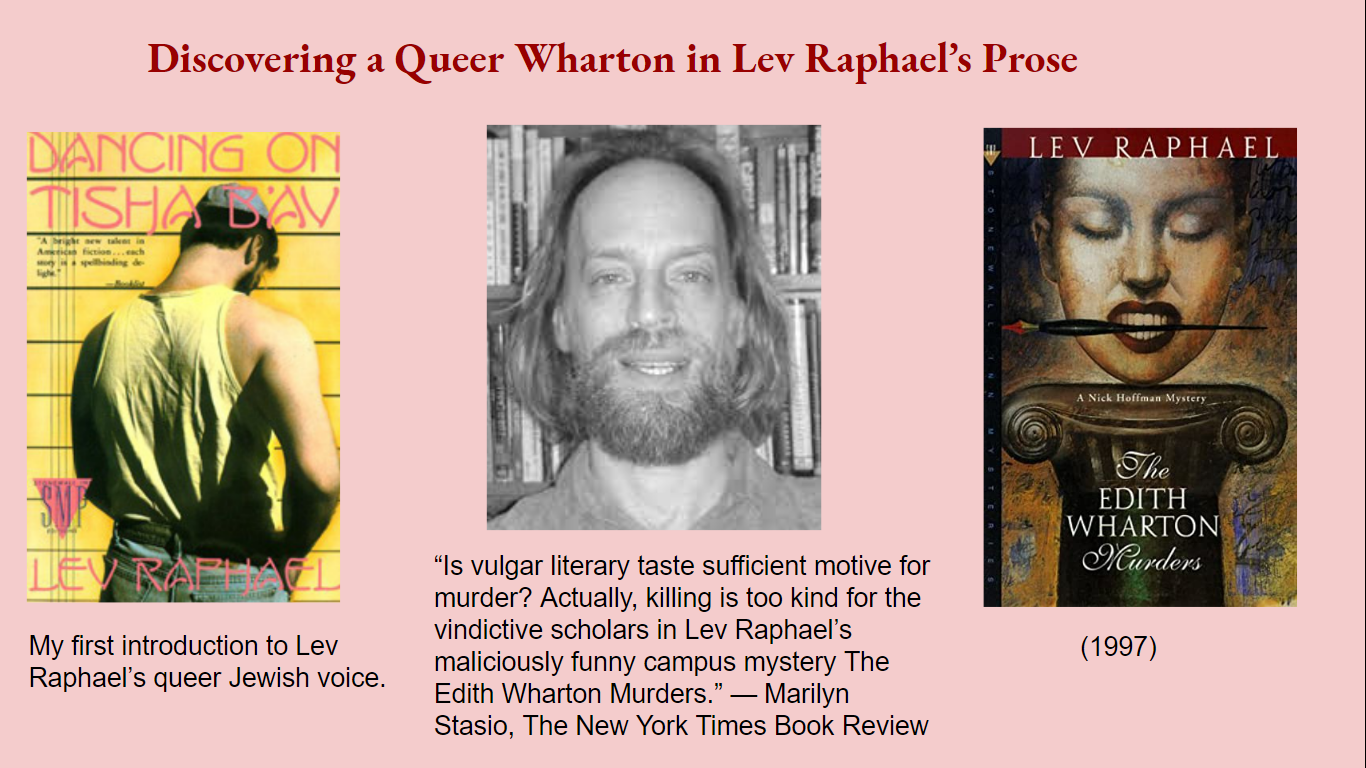
This Saturday, we’re bringing you an interview with Lev Raphael, and oh, how excited we are! Erika joins me as a guest co-host! Lev has two books in particular that speak to Whartonian themes: Rosedale in Love and The Edith Wharton Murders.
We in the Ivory Tower Boiler Room try to maintain a sense of positivity. That’s not to say we keep things light. But when we talk about something like sexual violence, we try to focus, not on the abuser or assaulter but on the survivor; on what they do to heal; on how their friends and other networks support them.
To that end we present to you two poems by poet Terri Muuss, one entitled “Poem Written while Listening to Brett Kavanaugh,” and the other entitled: “When my Rapist tried to Friend me on Facebook.” The latter is actually a video (you can also read the text here) of Muuss reciting her own work, while the former appears as black words on a white page.
These poems speak for themselves, but there is no harm in offering some ideas to keep in mind while reading/listening:
We as a society spend far more time discussing what women in particular, and assault/abuse survivors in general, can do to avoid putting themselves in harm’s way; but we spend relatively less time teaching people, and particularly men, not to assault or abuse. Teaching comes in many forms. If an abuser is not punished for their actions, that teaches other would-be abusers that their criminality will likely go unpunished, too.
If you are not yourself a survivor of abuse or assault, it can be difficult to achieve a good mindset in which to empathize with the speaker of these two poems. Allow yourself to feel uncomfortable; allow yourself to experience, through poetry, feelings for which you have no direct analog.
It’s also useful to remember that there are even levels of privilege among survivors. This statement is not meant to diminish the travails of more privileged people who have survived sexual abuse or sexual assault. Straight white women who are subjected to abuse or assault in these ways are more likely to receive support than queer people, BIPoC, men, trans or genderqueer people, and disabled people who have survived assault or abuse. Part of the problem is a dearth of empathy. People want to believe that bad news of any sort could not happen to them, so if a survivor of abuse or assault has any weakness in their character or in their story (and who among us does not?) or is merely unattractive and thus not a proper damsel in distress, or especially if the offender is powerful and connected, these are seen as excuses for why what happened to them could never happen to the observer or anyone dear to them. These rationalizations are not based in rationality, and it is our duty as survivors or allies to fight them. The appeal of poetry, likewise, is not based in rationality and so it can be one of our greatest tools.
Content Warning: Sexual Abuse, Grooming, Gaslighting.
This week, the second episode of Dr. Helana Darwin’s #MeToo PhD story drops. For those who did not catch the first episode, our guest, Dr. Helana Darwin–author, mother, award-winning scholar, qualitative research specialist–has entrusted us with her story of abuse at the hands of her own dissertation advisor.
As with last week’s episode, you’ll hear two distinct parts: The first part is in the usual format: Adam and Andrew conversing with Helana and listening as she tells her story. After that, Adam and Andrew are joined by Erika and Mary for a roundtable discussion in which the four of us try to process what we have heard. The roundtable discussion is a way for us to curate and emphasize certain themes that were brought up, but it’s also a way for us to engage in self-care; to take time to process the emotional difficulties raised in ourselves by listening to Helana’s story. We extend this invitation to our readers a second time: as you listen, please be aware of your emotions, and don’t be afraid to listen in sections. This recording will be too much for some people, for others it will be difficult but doable, and for others–particularly for people who have not had to endure this kind of trauma–it will be all too easy not to emotionally engage. All we ask is that you give Helana Darwin the fair hearing she has been denied by the university, the greater community of sociologists, and the justice system.
If you have a story you would like to tell, please do not hesitate to reach out to us on twitter (@ivoryboilerroom) or facebook.
A final note. Andrew and Adam reached out for comment to the administration of Stony Brook University. In the course of the roundtable discussion for part 1, Andrew, who is himself a sexual assault survivor, discussed his frustration with the SBU administrators’ response. For the sake of full disclosure, we are including all of our correspondence with the SBU administration here, with only the names and titles of our correspondents redacted.
In addition to the resources we brought you yesterday (which are available here,) the following additional links are discussed in the interview:
The Boiler Room is awash in excitement right now as we get ready to celebrate a whole year of podcasting with an open mic night at Words Matter Bookstore. Even Andrew did not imagine, when he and Adam started meeting to talk and write, what the Ivory Tower Boiler Room would grow into. Everyone in the Boiler Room is so glad to be here, and takes very seriously the mission and vision we’ve created for ourselves. Please join us to toast a year of progress and friendship!
We’re also glad to bring you the rest of our interview with Dr Helana Darwin, and to help her tell her #MeTooPhD story (you can find the first part here). Thank you Dr Darwin for sharing your story with us and with the world. We know the interview may be difficult for many people to listen to and want to remind you to use the resources we’ve provided if you need them… whether or not you do listen to the interview.
Back to the excitement mentioned at the beginning of this post, we hope this Saturday’s podcast interview with Lev Raphael is as exciting for you as it was for Erika. She certainly never imagined herself with an opportunity like that. She hopes she did a competent job and kept her fangirl squeeing to a respectable minimum.` You may recall that one of the phrases Erika is most known for in the Boiler Room is “Embrace the and,” and Lev Raphael’s work was extremely important in helping her learn to embrace her own “and,” so you’ll definitely hear some conversation about intersectional identities. The three of them talk about getting away from your roots, life in academia, and generational trauma, and how to transmit history without passing on the trauma. There’s also some chatter about the Gilded Age, and paying attention to details. You’ll have to listen to the interview to hear the really good parts though. When you do, perhaps you’ll be able to figure out what Erika thought the most squee-worthy moment was, too.
Over in True Crime, we’re extremely proud of Mary for finishing her three-week arc about the Gainesville Ripper. You can also check out parts one and two.
*
Big Cat, Little Cat
Script by Adam Katz; Photo by Erika Grumet. The roles of Big Cat and Little Cat are played by Frob and Widget, respectively.
*
*
Description: Two cats, the one to the left large and orange, looking down benignly, the one to the right small and grey, looking out of the frame with a distracted look. Big cat says: “Little cat, why do you think we work so well as friends?” Little cat answers: “Because my mood upon winning the lottery is your mood on a tuesday.”
Last week we brought you Part I of our interview with Dr Helana Darwin, who shared her #MeToo PhD story with us. We are incredibly grateful to Dr Darwin for sharing her story at all, and we are grateful to our audience for listening to Helana’s story. In only two weeks, Part I of Helana’s account has become our most listened-to episode. We only hope more people listen, and that Helana’s decision to come forward results in systemic change in the handling of #MeToo cases at Stony Brook and other universities.
Part II of Helana’s story drops in a matter of hours, and again, we are providing trigger warnings. If you yourself are a survivor of sexual abuse or assault or a related trauma, we welcome you to listen, but recognize it may be too much. Just as before, we thank you for being a good ally and listening with us if you are able, because Dr. Helana Darwin’s story is one that needs to be told and needs to be heard.
We continue to hope that the people who listen to this podcast become emboldened by Dr. Darwin’s example to break their own silences, or to help the people in their lives to do so. We know that Dr. Darwin did not need our help to break her silence, although the lack of support, both from her own department and from the broader community of her fellow sociologists, has been noted. Nevertheless, we feel that it is still our responsibility to offer any help we can–by lending her our platform and letting her talk. So we again extend this invitation to all of you: if you want our help breaking your silence, telling your story, or if you just want our help as a sounding-board, please do not hesitate to reach out.
In the meantime, if you or someone you know is experiencing sexual abuse, sexual assault, domestic abuse, intimate-partner abuse, grooming, gaslighting, or any other sexual- or relationship-trauma, please make use of the resources listed below. There is no substitute for a trained professional, such as a social worker, but it can feel daunting to take that step. So please reach out–to us, if not to anyone else. Being a survivor can feel lonely, and that’s a valid feeling, but it can also be true that there are people in your corner who want to help; people who know something about what you’re going through. And because our team includes survivors of sexual assault and intimate partner violence, we can and will continue to bear witness to the value of a supportive community in helping you heal.
*For immediate help in your local area, to find SANE (Sexual Assault Nurse Examiners–forensic nurses who have received special and additional training to care for the physical, emotional and psychological needs of sexual assault victims and survivors), you can contact the National Sexual Assault Hotline at 1-800-656-4673 (HOPE)
The Ivory Tower Boiler Room brought you a two part series about graduate school and mental health earlier this year. Here are links to those two episodes:
Andrew Tries to Figure Out His Identity as a Public Scholar
By Andrew Rimby
It’s been difficult trying to figure out how to begin my reflection on this month’s Big Think theme: Education and Public Scholarship. The reason? Because so many of my projects are categorized as public scholarship, but when I begin dissecting this category I’m left with many questions. So, why not begin with my first memory of engaging in public scholarship? Yes, quite a conventional chronological way to begin, but it was okay with Montaigne and indeed with Whitman so it seems fitting.
My first memory of what public scholarship looked like in practice, and not just theoretically in the classroom, happened when I went on my first Whitman walking tour with Dr. Karen Karbiener (this was around October 2017). I vividly remember meeting Karen at the annual English department party, held near the college, where I first met her through her husband, Dr. Douglas Pfeiffer (Adam’s dissertation advisor). I had just taken a course with Doug (I now refer to them by their first names and have gotten their permission, just in case the familiarity seems at odds with traditional academia, a point I’ll bring up soon) on the “History of the Book” which involved so many exciting adventures to different NYC-metro-based archives: the Morgan Library, Columbia University, the Beinecke at Yale, Princeton University, and of course Stony Brook’s Special Collections (run by Kristen Nyitray who is a wonderful collaborator of mine). Well, when Doug told me that I had met my Whitman critical advisor, I couldn’t stop the questions from forming and coming out of my mouth: “Karen, what is your interpretation of the ‘Calamus’ cluster, ‘Children of Adam,’ ‘Song of Myself,’ Whitman’s queerness, his self-publishing history of Leaves of Grass…?” And of course, Karen matched each question with an incisive response–like we were on the tennis court and it seemed as if the set would never end. I soon learned that Karen was going to be a seminar instructor for the annual Walt Whitman Week (hosted by The Transatlantic Walt Whitman Association) in Creteil, France (a suburb of Paris). That week, in the summer of 2017, changed the trajectory of my scholarly career. And it set in motion my identity as a public scholar.
While I had attended Karen’s walking tour right before the week in Paris, what sparked my interest in the boundary between the classroom and the public sphere was being around so many Whitman scholars, fellow graduate students, and undergraduate students who all shared a passion for Whitman’s poetics. I remember, with such fond memories, that I would be carrying Whitman’s 1860 edition of Leaves of Grass (this is my favorite because it contains the openly homoerotic “Calamus” cluster of poems) through the streets of Paris, while each person in the group would take turns reading different poems. It really changes your close-reading perspective when you are reading the poem “City of Orgies” (yes, it is called that) while on the Seine River, on a sightseeing boat in a city famous for its orgies. I think the ghosts of Oscar Wilde, Gertrude Stein, Colette, and Proust could be seen giving their looks of approval when we took a break to read from “Song of Myself” while touring the famous Parisian cemetery, Père Lachaise. I came away from that week realizing that my scholarly passion comes from the conversations had both in and outside the classroom. I always tell my students that so much analytic work happens when they leave the classroom. And, I could really tell that my queer readings of Whitman and Wilde would not be the same, if I had not gone to Whitman Week. And, without Karen’s passion for bringing Whitman out on the streets, especially through her NYC walking tours, I would not be the scholar I am now.
I would again cross paths with Karen, who by 2018 had become the outside reader on my dissertation committee, in the summer of 2018 when I audited her Columbia University course, “Whitman in New York”. By this time, I was working on a Whitman Bicentennial celebration happening at Stony Brook that featured an April poetry reading with Cornelius Eady and Rowan Ricardo Phillips, a Whitman symposium and concert with Matt Aucoin (the composer of Crossing, an opera about Walt Whitman and a recent guest on our podcast), and a walking tour through Stony Brook Village highlighting its 19th century history (all of this was in collaboration with my dissertation advisor, Dr. Susan Scheckel; the aforementioned Kristen Nyitray; and Brenda Harris, a professional opera singer and faculty member in the Music department). I know, so many Whitmanic (yes it’s a word) festivities happening on Long Island, and I didn’t even get to the part where I served as the graduate student representative for the annual Whitman Week, being hosted by Karen, in partnership with NYU. Talk about “for every atom belonging to me as good belongs to you” (an oft quoted line from “Song of Myself”). The 2019 Whitman Week was full of so much energy, engagement, and discourse that I kept in contact with so many participants (a few will be contributing some of their own writing and thoughts to The Ivory Tower Boiler Room, so stay tuned). I will forever be indebted to Karen who opened the interstitial door (think of it like Dorothy landing in Oz) that led from the university to the public. I have gotten pretty comfortable in this in-between land that allows me to engage with the public while also maintaining my university networks (the English department, undergraduate students, and collaboration with other departments, specifically Music and Special Collections).
(Listen to The Ivory Tower Boiler Room’s Interview with Dr. Karen Karbiener)
Now, I still haven’t fully answered how I define what it means to be a public scholar. Well, I’m going to let myself off easy by saying “there is no one way to define it” but there are projects I’ve done that definitely fit the bill. And, if I had to point to a concrete definition, I would look no farther than Serena Zabin’s “What is Public Scholarship?” article where she states that Public Scholarship “refers to diverse modes of creating and circulating knowledge for and with publics and communities.” This summer, I was involved in many projects that involved public scholarship. Here are a few examples:
I presented two talks, one on William Cullen Bryant and another on Edith Wharton, online with the Port Washington Library. Both talks centered on each author’s relationship with Whitman’s life and writing, and they broadly looked at Whitman’s queer poetics. Those in the audience consisted of both retired and current educators (university and K-12), creative writers, performing artists, medical doctors, lawyers, and overall, those interested in learning more about poetry. A few board members from the William Cullen Bryant estate, Cedarmere, asked questions that helped push my approach to the Bryant poems I had chosen to analyze. One member asked why I chose to focus on Bryant’s “To a Waterfowl” and “Midsummer” in relation to Whitman’s “To Bryant, the Poet of Nature”? This question excited me so much because it’s not one that I usually get to address in an academic setting. If I had given this talk at a conference, the 19th-century American Lit. scholars would, most likely, dig right into how I’m interpreting figurative language in Bryant’s “To a Waterfowl.” But, having to think about “why did I choose these poems” helps to articulate why I’m gravitating towards the theme of nature, as I see it in these three poems.
I then had a virtual walking tour, hosted by the Whitman Birthplace, about the literary history of Roslyn Village (Bryant, Whitman, and Wharton). My talks for the Port Washington Library set the stage for going to Bryant’s Cedarmere estate, located in Roslyn Harbor, and then visualizing Whitman and Wharton’s discussion of Long Island’s Gold Coast (the Gilded Age wealth on the North Shore). One audience member, our very own Rusty Rose, volunteered to send her poetry, reflecting on Whitman, to The Ivory Tower Boiler Room, and she then gave more history about the Roslyn clock tower (a staple in that village). She also commented on how a virtual walking tour allows for more people to attend. This warmed my heart since making my walking tours more accessible is of utmost concern to me.
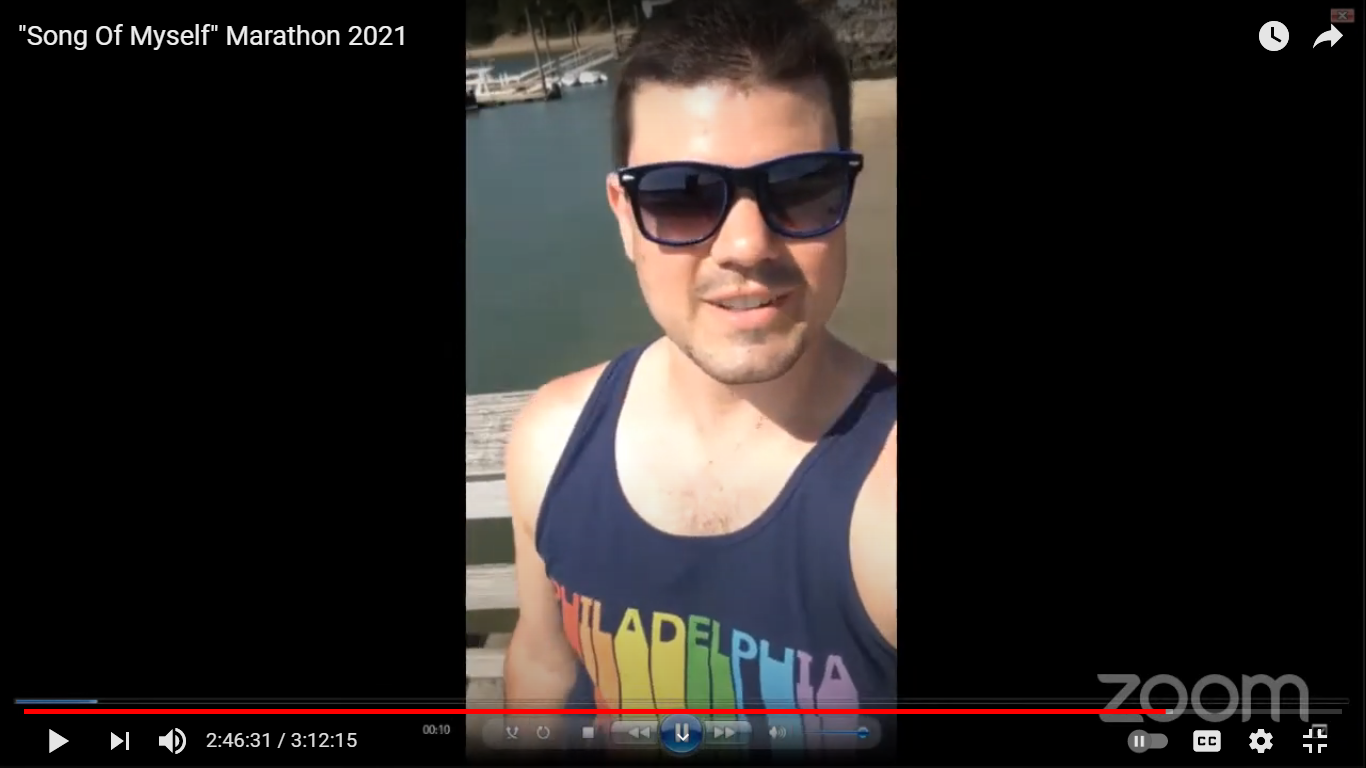
As a board member of the Walt Whitman Initiative, I then got to participate in such an energizing “Song of Myself” marathon, led by the enigmatic Dr. Karen Karbiener, which is held every year in celebration of Whitman’s birthday. This year was Whitman’s 202nd birthday so I actually got to be among fellow Whitman enthusiasts, including Lenny Kaye and Rosanne Cash. I really enjoyed reading Section 45 from “Song of Myself.” And at the Whitman Birthplace, Caitlyn Shea, the Events and Media Director, and Cynthia Shor, the Executive Director, led a 202nd Birthday bash where I got to read “Of Him I Love Day and Night.”
While you all catch up on these videos (and what a pleasure each event truly was to be a part of), I think these examples have helped me articulate, to myself, what being a public scholar entails. I promised at the beginning of my Big Think that I would eventually figure out the questions to ask if you are doing public scholarship. Well, here are a few that are present in the example projects I gave.
Does the project make specialized research accessible for a general audience?
As the speaker, do you make sure that multiple communities are being addressed (this includes organizations that you partner with as well as communities that you belong to, for example, how I belong to an LGBTQ+ community, academic community, and writing community)?
Is the material easy to access and shareable? (YouTube videos work wonderfully, as do podcasts.)
Most importantly, for me is, does interacting with such a diverse community begin to impact the way you view your specialty? I know that without my public events, I would view Whitman’s queerness more rigidly instead of enjoying how fluid his erotic voice is.
Well, there is so much more I could add, but I want to put a bookmark in this. Next month, I’ll be reflecting on a current public scholarship and Humanities project, The Ivory Tower Boiler Room, and what it means to have co-created it with Adam Katz. I couldn’t think of a more concrete example of public scholarship than The Ivory Tower Boiler Room community. Until next month…
(Andrew reading Section 45 of “Song of Myself” at Port Jefferson Harbor)
Andrew Reads (and Laughs along with) New York Times Theater Critic Jesse Green
For this Sunday’s bookshelf feature, I want to discuss my reading of Jesse Green’s “A Chance to Fix the Tonys, and So Many Things to Fix” (released on June 2nd as a Critic’s Notebook feature).
I’m still trying to feel my feet touch the ground after having had the opportunity to interview Jesse, with Adam for the podcast, and I’m quite the fan since I’ve featured many of Jesse’s articles in my classroom, as examples of how to write a theater critique. Though not a play review or musical review, this feature-article of Jesse’s is a call to action where he asks whether or not the Tonys (happening on September 26th, 27 months since the last ceremony) have questioned “Broadway…traditionally favor[ing] the financiers over the artists in its shotgun wedding of art and commerce.” (Oh, Jesse, what a phrase!) For those not in the know, basically, the financiers of a Broadway show are like the administrators of a university: they have inflated budgets and salaries, while exploiting the creatives. And Jesse uses the example of the overwhelming number of producers who run onstage to claim the Best Musical award, while the audience can barely pick out the cast and creative team. As a fellow Broadway enthusiast (I’m listening to the Sirius XM Broadway channel as I’m writing this–72 for other enthusiasts!) and I completely relate to Jesse’s desire for a Tony Award ceremony that privileges the actual artists over the financial backers. He asks another hard hitting question which is: “Why should the best show people somehow keep making the dullest, tackiest hodgepodge of a show?” Yes, Jesse doesn’t mince words, which is what is so refreshing about his writing, and there are so many layers that must be addressed, Jesse writes, in order for equity to exist during the night of the Tonys.
For example, not only did the Broadway community lose so many of its members from the pandemic, but the community is also reckoning with “the racism long built into the theatrical ecosystem.” As with so many institutions in America, the theater community is not without its systemic racist legacy. Many BIPOC artists, especially in the Broadway community, have been speaking out about the need to air this racist history and about what must be done to end this racist legacy. The playwright Lydia R. Diamond explains that with so many intellects present in the theater community that if they can “figure…out how to make people buy seats at between $150 to $500” then they “…can figure out how to not be racist.” The problem, Diamond says, is “there’s not a real investment in it [ending systemic racism]. There just isn’t. And that’s how our country has functioned. We talk a good game about it. All of the institutions are writing letters about how they stand in solidarity. But until you show me institutional change, I don’t want to hear it.”
I’m in complete agreement with Jesse that having two hours dedicated to three awards may actually be the inertia needed to center the artists, and actually let them be in charge of directing the theatrical segments of the Tonys (excerpts from the honored plays and musicals). I hope that Jesse is right that this year can be a major turning point where Broadway uplifts its artists, instead of needing to appeal to investors and favor “…the commercial side so fawningly” (Green). Oh how wonderful it would be to have either Billy Porter or Meryl Streep host the Tonys this year (may I enter Audra McDonald’s name in the hat?). Jesse’s writing has a magical aura of manifestation that I’m onboard with; it feels as if, as I’m reading the article, his words are becoming reality before my eyes, and I truly hope that his wish comes true: that this year’s Tonys, allow for “drop-dead production numbers and quieter, more intimate moments to create rhythm more like the experience you actually get on Broadway.” As the saying goes…from Jesse’s mouth to God’s ears…or something like that.
The Ivory Tower Boiler Room brought in an authority on writing, theater, and of course journalism. So naturally he and Andrew talk about Whitman the entire time.
It’s fine. Jesse wrote an article on Whitman, and that was how he and Andrew originally connected.
Elsewhere in the interview, Jesse gets quite detailed in describing his writing process. For those of you who beat yourselves up by saying things like: “I procrastinate so much; I’ll never be a professional writer,” all we have to say to you is: “the more you know…”
The best thing that can be said about this conversation–as with any conversation–is that it feels too short. There were so many more questions to ask; so much more theater gossip to swap back and forth; so many more favorite performances gush over (and least favorite performances to dish about). But in the end, it has been a long week for all of us at the Ivory Tower Boiler Room, and in such situations, it can be a comfort to kick back and talk about writing with a fellow-practitioner of the craft. And we hope you agree that when we get together and do just that, the energy is infectious.
Thanks for sticking with us all week. Covering the topics we covered the past few days may not have been pleasant, but watching the numbers tick up as our readers and listeners gravitated to the topic certainly was pleasant. It’s important to see that there are people committed to helping certain buried or glossed-over stories get the attention they deserve. We are going to pick Dr. Darwin’s story up again next Wednesday, but in the meantime we have some lighter fare scheduled for this weekend.
Tomorrow, The Ivory Tower Boiler Room team is quite excited to release “Backstage with Jesse Green, the chief NY Times Theater Critic.” We still can’t believe that it all began with Andrew’s undergraduate professor, Dr. Dan Gover reading Andrew’s “Talking Back to Walt Whitman” essay and asking if Andrew had read Jesse Green’s NY Times Whitman piece, “Walt Whitman, Poet of a Contradictory America.” And, as is expected with Andrew’s interest in Whitman’s queer poetics, he has turned to Jesse’s essay multiple times for teaching queerness in Whitman’s poetry. Well, not only did Andrew fan out when getting the chance to interview Jesse, but so many topics get addressed. Everything from Andrew and Jesse growing up in the Philly suburbs (opposite sides of the Delaware River), Adam picking Jesse’s brain about his writing process, Andrew wanting gossip about Broadway stars, and of course, all three divulging their favorite theater experiences. This is not an interview you want to miss, and we also had some other titles, but sadly, they didn’t make the cut.
“Where is that Jersey Diner: A Generational Dilemma”? (you’ll get it after listening to the episode)
“Broadway Gossip with Jesse Green”
“Are Broadway Creatives as Crazy as they Seem? (Yes, but Often in a Good Way)”
So much for the verbal portion. As our regulars know, we always send a set group of questions to our interviewees. So let’s see how Jesse Green did on the written:
> 1.What are you listening to, reading, watching?
listening to: frogs, woodpeckers, turkeys, show tunes
reading: Dorothy Parker, Alison Bechdel, Paul Rudnick, Ibsen
watching: “Dix Pour Cent,” “Shtissel,” “Pose,” “Derry Girls,” “Special”
> 2.Do you like to cook? What is your favorite thing to make?
I do like to cook but I am more the sous chef in our family. My favorite thing to make is maple-nutmeg pie.
> 3.What is something you have read and loved, and wish more people would read?
The novels of William Maxwell: “The Folded Leaf,” “The Chateau,” “So Long, See You Tomorrow,” etc.
> 4.Did you grow up with video- or computer-games? What were/are some of your favorites?
I totally did not. And even though my kids did, I never got into it.
> 5.You’re taking a sick-day from work. What movie are you putting on.
“God’s Own Country,” any Fred Astaire movie
> 6.What’s your favorite excuse for why you have writer’s block?
My excuse is more a truth than an excuse: Writing is hard. And blocks should be honored. Also, my solitaire app is very inviting.
> 7.What’s a book everyone says you should read, but you either read it and hated it, or haven’t read it.
I won’t name names.
*
If all the salacious reading she’s been doing wasn’t already enough, Erika finally got around to watching season 2 of Sex Education this week. With the amount of time she spent teaching human sexualtiy and related topics, it’s interesting for her to see the relationship between Gillian Anderson’s character and Asa Butterfield’s character, and how they do (or don’t) navigate healthy boundaries between parent and child around sexuality. She also took time to binge watch My Unorthodox Life and Season 2 of Never Have I Ever on Netflix this week. This week’s YouTube viewing has mostly been Verily Bitchie–mostly the vampire videos and the bisexuality videos…although it’s best when you can have both at once.
Erika has been listening again to episodes of our podcast; she says it’s comforting to hear Adam and Andrew talking while working on difficult things. She’s taking Adam’s suggestions into consideration and listening to Beethoven, too. She als turned to her Walk the Moon playlist for a pick me up this week. On July 14, while honoring Bastille Day with the rest of the Buck’s Rock campers, staff and alumni, she posted to Facebook and quote Crosby, Stills, Nash and Young, and since they appear on a number of camp related playlists, their music took up some of her working afternoon. And just because it’s great fun and almost guaranteed to make her feel better, she’s listened several times to Thomas Benjamin Wild’s “I’ve No More Fucks to Give.”
For the first time since really getting started on the Ivory Tower Boiler Room’s website and blog, Erika wrote a (first draft of a) poem this week! While she may rail against accepting the label “poet,” she does enjoy writing them…when they work. She’s not sure if it’s just because there’s space in her brain right now after the workload involved in getting the blog and site up and running and then writing some very serious content for Pride month, or inspiration after reading Danez Smith ‘s”Don’t Call Us Dead” and Natalie Diaz’s “Post Colonial Love Poem.” She also brought out Kevin Hearne’s “Hounded” (the first book in the Iron Druid Chronicles series,) for a re-read, since she would like eventually to finish the series. This week she’s going to go searching for things to accompany her reading of Sarah Schulman’s “Let the Record Show,” so help her out with some lighter suggestions to counter the serious history.
Andrew has tuned into the new reboot of Gossip Girl because he is quite obsessed with Upper East Side soap opera dramas (Cruel Intentions comes to his mind). He is going to see his friend, who works at the Whitman Birthplace, for a trip to the theater to see Black Widow on Saturday. He says that before he goes to the movie theater, they will go on a hike in Cold Spring Harbor (what’s that saying about work and play?) We can ask him for pictures, too.
While he’s walking, Andrew is listening to Shirley Bassey on repeat, since it helps to keep him in an uplifted and positive spirit. His favorite live concert of hers is when she comes back to Cardiff, Wales (her hometown), especially around minute 25 of the recording when she starts “Big Spender” and then transitions to “You Ain’t Heard Nothing Yet” (you will instantly be smiling).
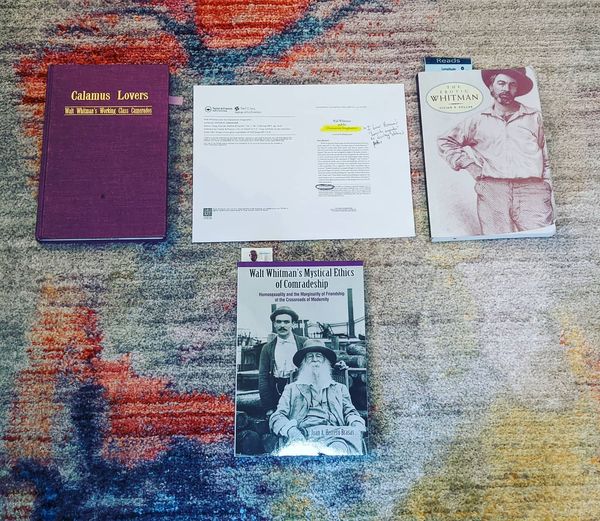
Andrew’s Audible account is running full-speed, with 14 hours left of James Baldwin’s Just Above My Head so he will be spending the rest of the summer with Baldwin’s prose. We can also find him back in a familiar place; he is doing some Whitman and homoeroticism research for his current dissertation chapter. See some of the texts below:
Adam’s time with his brother in the northern wilds is sadly coming to a close. No more daily thunderstorms, no more wild raspberries (they’re an invasive species anyway…) and no more nights watching Ted Lasso while eating homemade hummus, palak paneer, and other delicacies.
Meantime, Adam has been rereading A Supposedly Fun think I’ll Never Do Again by David Foster Wallace,
Listening to the usual Bach, Schubert, and Ravel, and watching the aforementioned Ted Lasso.
Ever the researcher, Mary is still reading through tons of information for the last installment of The Gainesville Ripper. Next week’s episode dives into Danny Rolling’s most gruesome crimes that gave him the name Gainesville Ripper.
This week Mary finally has a song recommendation for us! “Hunnybee” by Unknown Mortal Orchestra. This song is light and interesting and overall an escape for this Ivory Tower Boiler Room team member. Mary also likes that this song reminds her to take care of the bees-specifically honey bees- despite that she really does not like ANY bugs.
On the screen, Mary watched the beginning of The Tomorrow War and was a huge fan of the beginning. Her disinterest in alien movies has stopped her from watching the whole movie though, and that wasn’t helped when she was able to figure out the conclusion to one of the more major plotlines (confirmed by her movie buff boyfriend who watched the movie) so she is more eager to see how that part plays out and less about alien action.
From our Boiler Room to you, we hope you have a good weekend, and take the time to enjoy some good things for yourself. We’d love your recommendations for what we should read, watch and listen to here in the comments, in an email or on social media. Share some favorites with us.
-The Ivory Tower Team
PS Help fund our book habits! Support our sponsor Words Matter , and don’t forget you can donate to us directly through the link on our homepage.
Terri Muuss is a practicing social worker, as well as a poet, director, and much else besides. Muuss’s social work blends with her avocation for poetry and theater; both deal extensively with healing from trauma. Given that yesterday (7/14/21) we dropped a new interview on our podcast dealing with the same subject, we thought that releasing these two–the interview with Dr. Helana Darwin and these two poems by Terri Muuss–would be appropriate.
We hope you enjoy reading Muuss’s powerful writing, and welcome you to share your thoughts with us in the comments section, or privately, if you prefer, using the “contact” page.